ERP vs CRM: Complete Guide for SMEs
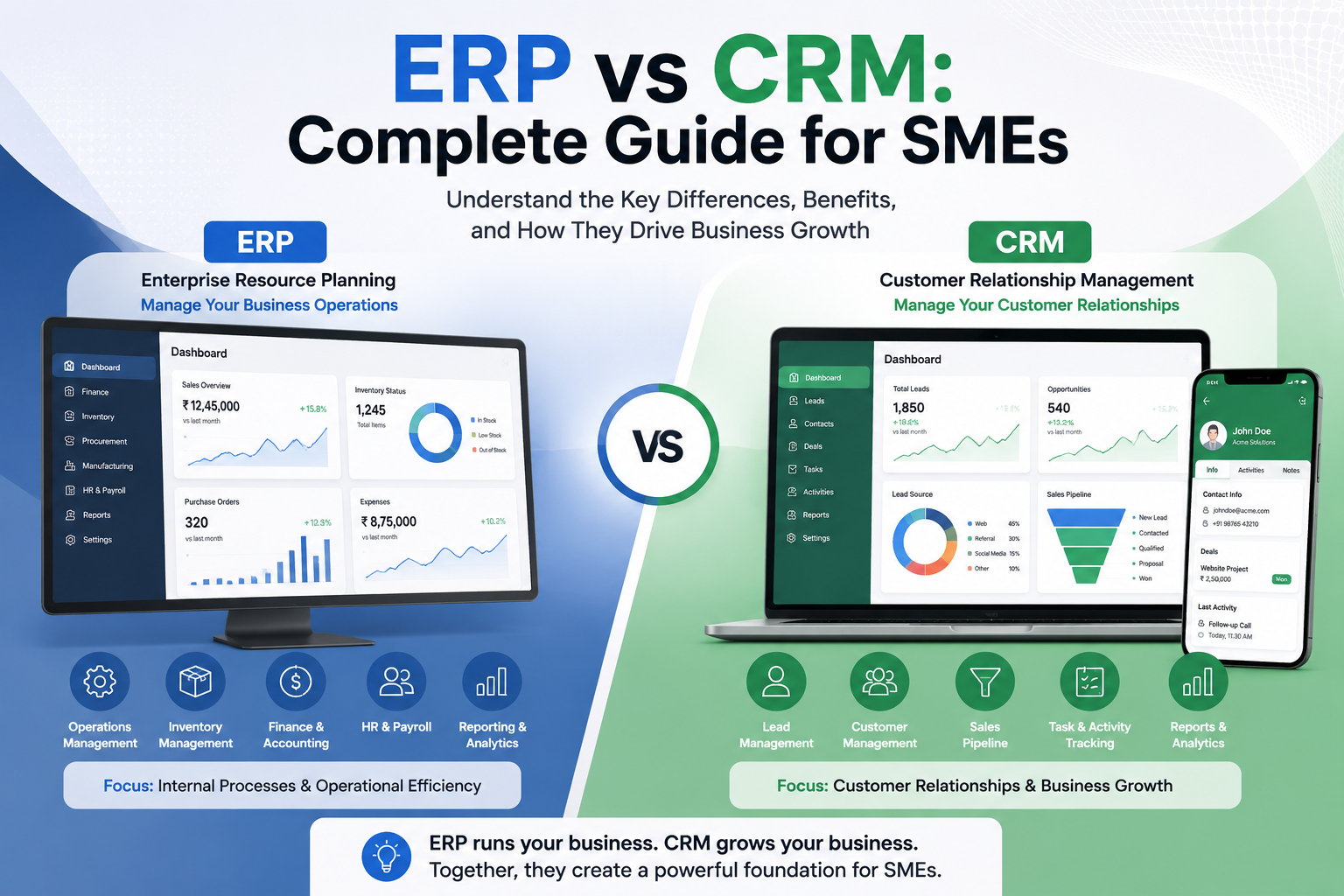
Small and medium-sized businesses often hear about ERP and CRM at the same time, but these systems solve different problems. ERP helps manage internal operations, while CRM helps manage customer relationships. Understanding the difference can help SMEs choose the right software at the right stage of growth.
Introduction
As a business grows, managing sales, finance, inventory, customer data, and operations becomes more complex. Many SMEs start with spreadsheets or disconnected tools, but that approach quickly creates errors, delays, and poor visibility.
This is where ERP and CRM software come in. Both are important, but they are built for different purposes. ERP focuses on efficiency behind the scenes, while CRM focuses on how businesses interact with customers. Knowing how they work helps SMEs make smarter technology decisions.
What is ERP?
ERP stands for Enterprise Resource Planning. It is software that connects core business processes in one system so teams can work with shared data and better control.
An ERP system typically handles:
Accounting and finance.
Inventory management.
Purchase and procurement.
Order processing.
Human resources.
Warehouse operations.
Reporting and analytics.
For SMEs, ERP is valuable because it reduces manual work, improves accuracy, and gives a complete view of business operations.
What is CRM?
CRM stands for Customer Relationship Management. It is software designed to help businesses manage leads, customers, sales activities, and service interactions.
A CRM system usually includes:
Lead tracking.
Contact management.
Sales pipeline management.
Follow-up reminders.
Email tracking.
Customer support records.
Sales performance reporting.
For SMEs, CRM is useful because it helps teams close more deals, improve customer service, and build stronger long-term relationships.
How ERP Helps SMEs
ERP software is especially useful for SMEs that are starting to face operational complexity. When business data is spread across different tools, teams often waste time reconciling numbers and chasing updates.
ERP helps by:
Centralizing data in one place.
Reducing duplicate entries.
Improving financial accuracy.
Tracking inventory in real time.
Streamlining approvals and workflows.
Making reporting faster and more reliable.
For a growing SME, ERP creates a strong foundation for scaling operations without losing control.
How CRM Helps SMEs
CRM software is ideal for SMEs that want to improve sales efficiency and customer retention. Without a CRM, important follow-ups can be missed and sales opportunities can slip away.
CRM helps by:
Organizing customer and lead information.
Tracking every stage of the sales process.
Improving communication with prospects.
Supporting faster follow-ups.
Helping teams deliver better customer service.
Identifying sales trends and opportunities.
For SMEs focused on growth, CRM improves visibility into the customer journey and helps teams convert more leads into revenue.
Which One Do SMEs Need First?
The answer depends on the business challenge.
Choose ERP first if your biggest problems are:
Disorganized operations.
Inventory issues.
Financial reporting delays.
Manual data entry.
Poor internal coordination.
Choose CRM first if your biggest problems are:
Weak lead tracking.
Missed follow-ups.
Low conversion rates.
Poor customer visibility.
Sales team coordination problems.
Some SMEs need ERP before CRM, while others need CRM before ERP. The right choice depends on whether the business needs to improve operations or sales performance first.
Can ERP and CRM Work Together?
Yes, and in many cases they should. When ERP and CRM are connected, businesses get a more complete view of both operations and customers.
For example, a sales team can see order status, stock availability, and billing information without switching between systems. At the same time, operations teams can see incoming demand and prepare accordingly.
This integration improves:
Data consistency.
Team collaboration.
Customer experience.
Decision-making.
Business efficiency.
Benefits of Using Both
When ERP and CRM work together, SMEs can benefit from both operational control and customer growth.
Key advantages include:
Better visibility across departments.
Faster decision-making.
Improved customer service.
More accurate forecasting.
Reduced manual work.
Stronger sales and operations alignment.
This combination helps businesses become more efficient internally while also becoming more responsive to customers.
Common Mistakes SMEs Make
Many SMEs make the mistake of choosing software based only on price or popularity. Others buy too many tools too early and end up with systems that do not connect well.
Common mistakes include:
Confusing ERP with CRM.
Choosing software without clear business goals.
Ignoring integration needs.
Buying features they do not actually use.
Not training teams properly.
Failing to plan for future growth.
A better approach is to identify the biggest business problem first and then choose the system that solves it.
Final Thoughts
ERP and CRM are both important for SME growth, but they are not the same. ERP improves internal operations, while CRM strengthens customer relationships. Understanding the difference helps businesses invest in the right system at the right time.
For many SMEs, the best long-term strategy is not choosing one over the other, but building a connected system that supports both operations and sales. That creates better control, stronger customer relationships, and a more scalable business.
Related Insights
What Is Logistics ERP Software?
Logistics ERP software is a centralized system that helps logistics, transportation, warehousing, and supply chain businesses manage their operations from one platform. It connects key functions like order management, inventory tracking, fleet coordination, billing, warehouse operations, and reporting, so teams can work with more accuracy and less manual effort.
How AI-Powered CA Operation Systems Like CAIQ Are Revolutionizing Audit & Compliance for Indian CA Firms in 2026
Are you a Chartered Accountant struggling with manual audit processes and overwhelming compliance workloads? CAIQ by Creonox is the AI-powered CA operation system that transforms how CA firms operate in 2026. It automates audit execution, GST filing, Income Tax returns, and MCA compliance while detecting fraud patterns. CA firms achieve 70% time reduction, 90% fewer errors, and complete 3x more audits with the same team. Visit caiq.creonox.com to request your free demo.
Why Most Businesses Don't Need More Software — They Need Better Operating Systems
Most businesses don't suffer from a lack of software—they suffer from disconnected systems. Discover why intelligent operating systems are becoming the foundation of modern business operations.